The Sound of Certainty Without the Substance
In a conference room that smelled of cold coffee and dry-erase markers, a legal team reviewed a brief their AI assistant had drafted overnight. The citations were perfectly formatted. The prose read like a senior associate's work authoritative, measured, with the kind of hedging that signals scholarly caution. One attorney flagged a concern: the citations didn't resolve. Not a formatting error, but fabricated case law, rendered in flawless Bluebook style. The language had done its job so well that the deception almost survived scrutiny.
This is the honesty gap in artificial intelligence and it is not what most people think it is.
The concern is not merely that AI systems can be wrong. Systems have been wrong for as long as software has existed. The anxiety, as Daryl Ledyard and Philip Tyler describe in GenXis Research, is that AI can be wrong in fluent, reasonable, socially persuasive language. A legal citation can be fabricated in perfect legal prose. A medical explanation can sound clinically plausible while omitting a contraindication. A financial summary can appear authoritative while relying on stale facts. In each case, the danger comes from the mismatch between linguistic confidence and verified grounding.
Most commentary on AI honesty frames the problem as a bug to be patched better training data, stronger safeguards, human-in-the-loop oversight. But there is a contrarian reading of the honesty gap that is more uncomfortable and more useful: the very features that make AI valuable are the ones that make it dangerous. Language fluency is not an improvement on AI's honesty problem. In certain configurations, it is the honesty problem.
What the Honesty Gap Actually Means
GenXis Research defines the honesty gap as "the distance between persuasive language and verified truth." This framing is precise because it separates two things that language naturally conflates: the experience of being persuaded and the state of having accurate information.
"Words can escape meaning," Ledyard and Tyler write. "They can rationalize, soften, blur, excuse, reframe, and drift." In human psychology, these tendencies appear as motivated reasoning, cognitive dissonance reduction, moral disengagement, and what researchers call ethical fading the gradual disappearance of ethical considerations from decision-making narratives. In AI systems, the same linguistic pathology appears as hallucination, unsupported synthesis, and citation-shaped language without source custody.
The root problem, according to the GenXis framework, is the "squishiness of words." Language can preserve signal, but it can also metabolize error into something that sounds reasonable. Over time, small verbal deviations compound like a singer drifting slightly off pitch until the tonal center is lost. The singer may still sound confident. The audience may still nod along. But the original key is gone.
Consider the definition Ledyard and Tyler offer: "A claim is not merely a sentence. It is a tuple where is the statement, the domain, the truth condition, and the evidence requirement." Without those elements, language remains expressive but under-bounded. It may point toward a reality without specifying the procedure by which that reality is checked. The sentence "this was handled responsibly" may be true, false, evasive, or meaningless depending on hidden definitions. What counts as responsible? Which model? What evidence? Which circumstances?
The Contrarian Case: Why Fluency Makes Things Worse
The conventional wisdom holds that AI systems will become more trustworthy as they become more sophisticated. Better language understanding, more training data, stronger alignment techniques these will close the honesty gap.
The contrarian view is that this optimism misidentifies the mechanism. The problem is not insufficient language skill. The problem is that language, by its nature, is optimized for persuasion, not verification. As AI systems grow more persuasive, they grow more dangerous in inverse proportion to their verifiability.
Natural language is flexible by design. It allows approximation, metaphor, implication, emphasis, ambiguity, and context dependence. These features make language humanly useful. They also make it a weak carrier of machine-grade certainty. A human advisor whose reasoning is flawed often betrays the flaw through hesitation, inconsistency, or inability to elaborate. An AI system with the same flaw can generate confident elaboration indefinitely not because the reasoning is sound, but because fluency is a different capability than truth.
"The worry is not merely that systems hallucinate," Ledyard and Tyler observe. "The worry is that hallucinations arrive in the same polished form as true answers." This is the core of the contrarian insight: we have built AI systems that are expert at the performance of knowledge without being expert at knowledge itself. And as the performance improves, the gap between performance and reality widens.
A Precedent From Education Policy
The honesty gap is not unique to AI. The same dynamic where reported performance diverges sharply from verified performance has been documented extensively in education policy, and the history offers a useful map of what happens when the gap goes unaddressed.
The U.S. Chamber of Commerce Foundation, in partnership with the Collaborative for Student Success, defines the educational honesty gap as "the difference between how students perform on the national gold-standard assessment (NAEP) and how they perform on their own state's tests." When states lower the bar for proficiency, achievement data can paint a misleading picture that affects students, parents, educators, and ultimately the workforce.
The 2024 state-by-state analysis documents the scale of this divergence. In Iowa, the 2024 state-reported 8th grade math proficiency rate is 72%, while NAEP reports only a 27% proficiency rate a 45-percentage point difference. In Virginia, the 2024 state-reported 4th grade reading proficiency rate is 73%, while NAEP reports only a 31% proficiency rate a 42-percentage point difference.
These are not outliers. As the Collaborative for Student Success noted in their analysis, "In many states, the gaps suggest that parents simply aren't getting the full picture of how prepared their kids are for college or the workforce."
The education parallel matters because it shows what the honesty gap looks like when humans are the source of the divergence and what happens when the gap persists. Dale Chu, writing for the Thomas B. Fordham Institute, documented how the problem compounds: "Compounding the problem is rampant grade inflation, which only got worse during the pandemic and has since widened both performance and attendance gaps." Taken together, the inaccuracy in reporting grades and test scores is "a devastating one-two punch."
That passage, from the introduction to The Proficiency Illusion by Checker Finn and Mike Petrilli written more than fifteen years ago anticipated the AI honesty gap with uncomfortable precision. The same forces that produced inflated proficiency rates in education are at work in AI systems: the incentives to report favorable numbers, the absence of a shared verification standard, and the tendency of language to smooth over inconsistencies that would be obvious in structured data.
Hallucination Is Not the Same as Dishonesty
One of the most consequential confusions in public discourse about AI is the conflation of hallucination with dishonesty. They are not the same thing, and the distinction matters for how the problem is solved.
Hallucination, in the technical sense used by AI researchers, refers to the generation of content that appears well-grounded but is not tethered to source material. A fabricated citation is a hallucination. A plausible-sounding medical explanation that omits a key contraindication is a hallucination. These errors are real, and they are dangerous but they are not the product of intent. The system is not trying to deceive. It is trying to be helpful, and the helpful response happens to be wrong.
Dishonesty, by contrast, requires intent. It requires the deliberate use of language to obscure, mislead, or misrepresent. In human contexts, dishonesty is a moral failure. In AI contexts, the moral framework is different not because AI systems are exempt from accountability, but because the mechanism of error is different.
The GenXis framework is useful here because it focuses on the structural conditions that produce the gap rather than assigning moral blame. "The antidote is not less language, but stronger grounding: mathematical constraint, source custody, deterministic checks, calibrated abstention, and evidence memory." This is a technical prescription, not a moral one. It recognizes that language will continue to be used to communicate AI outputs while insisting that communication must be anchored to verification procedures that language alone cannot provide.
Why the Distinction Matters for Trust
If hallucination is not dishonesty, then the trust problem in AI is not primarily about bad actors or malicious systems. It is about the structural mismatch between AI's communication capabilities and its verification infrastructure.
Cory Koedel, a professor of economics and public policy at the University of Missouri-Columbia, identified the same dynamic in education when he wrote that "the education system often fails to communicate honestly with students, parents, and community members about how much students are actually learning." The problem was not that educators were lying. It was that the system had collectively lost its appetite for bad news and the language of grades, proficiency ratings, and progress reports had drifted away from the verifiable reality measured by standardized assessments.
The parallel to AI is instructive. Language models are trained to be helpful, and helpful responses tend to be confident, fluent, and agreeable. The training objectives do not directly reward verification they reward coherence and task completion. Over time, this produces systems that are very good at the performance of knowledge and increasingly distant from the practice of verification. The result is not malicious AI. It is AI that has absorbed the same habit as human institutions: the preference for a favorable narrative over an uncomfortable one.
The Architecture of Verification
If the honesty gap is structural rather than moral, then the solution is also structural. Ledyard and Tyler's framework points toward a verification architecture built on five pillars: mathematical constraint, source custody, deterministic checks, calibrated abstention, and evidence memory.
Mathematical constraint means grounding claims in formal systems where correctness can be mechanically verified. Instead of asking whether a sentence sounds true, the system generates outputs that can be checked against computational procedures. This is not a new idea formal verification has been used in software engineering, hardware design, and mathematical proof-checking for decades. What is new is the application of these techniques to natural language generation.
Source custody means maintaining a verifiable chain between any claim and its origin. If a system generates a citation, the citation must point to a document that exists, was consulted during generation, and can be retrieved for verification. Citation-shaped language without source custody is precisely what the GenXis framework identifies as a symptom of the honesty gap.
Deterministic checks are procedures that produce the same output given the same input, eliminating the variability that makes probabilistic language models hard to audit. Calibrated abstention means the system must be trained to decline to answer when confidence is insufficient not to generate a plausible-sounding response when the evidence is thin. Evidence memory means maintaining a record of what the system knew, when it knew it, and how it was updated.
These pillars are not equally developed in current AI systems. Source custody and evidence memory are particularly underdeveloped, which is why the honesty gap persists even as language capabilities improve. Building these capabilities requires investment in infrastructure, not just model architecture and it requires accepting that some of the fluency that makes AI systems useful will need to be traded for verifiability.
Can AI Be Trained to Be Completely Honest?
The question of whether AI can be trained to complete honesty is, in the framing of the GenXis framework, a category error. Completeness is not a realistic training objective because any system that generates language will generate language that can be wrong, misleading, or poorly grounded. The question is not whether AI can be completely honest. It is whether the gap between what AI says and what AI can verify is narrow enough for the use case.
For high-stakes applications legal drafting, medical triage, financial reporting, security analysis the answer requires a verification architecture that goes beyond language. It requires structured data, audit trails, deterministic outputs, and human review processes that are calibrated to the system's error patterns. For lower-stakes applications, the bar can be lower, but the honesty gap does not disappear it is simply less consequential.
The education policy parallel is again useful. Massachusetts and Rhode Island closed their honesty gaps to within 5 percentage points or less across both grades and subjects. Fourteen states are holding students to an equal or higher standard than NAEP in at least one grade or subject. The gaps have narrowed where there has been sustained commitment to rigorous standards and transparent reporting.
The lesson for AI is that closing the honesty gap is possible but requires institutional commitment to verification over convenience. States that lowered proficiency thresholds did so because the alternative reporting poor performance was politically costly. AI systems face similar incentives: the incentive to generate helpful-sounding responses is strong, and the cost of admitting uncertainty is often higher than the cost of generating a confident error.
Why This Matters for GenXis Research Readers
GenXis Research covers the persuasive fluency of AI language models because fluency is the mechanism through which the honesty gap operates. A rough answer that is obviously rough is less dangerous than a polished answer that is subtly wrong. The coverage is not about whether AI is good or bad. It is about understanding the structural conditions that make AI systems more or less reliable and about building the mathematical and deterministic infrastructure that can close the gap between what AI says and what it can verify.
For practitioners evaluating AI systems for deployment, the honesty gap framework offers a diagnostic tool: Where is language being used as a substitute for verification? Where are citations shaped but sourceless? Where is the system generating confident responses to questions it should decline? These are not failures of AI. They are features of any system that uses language to communicate without grounding communication in procedures that language cannot itself provide.
The contrarian insight is that fluency is not progress toward honesty. In the absence of verification infrastructure, it is the condition that makes the honesty gap dangerous. Building that infrastructure mathematical constraint, source custody, deterministic checks, calibrated abstention, evidence memory is the work that the gap makes urgent.
Where to Read Further
For a rigorous technical framework on the honesty gap concept as it applies to AI language models, start with Daryl Ledyard and Philip Tyler's GenXis Research paper on the Honesty Gap, which introduces the core definition and the five-pillar verification architecture.
For the education policy precedent that illuminates the same dynamic in human institutions, the U.S. Chamber of Commerce Foundation's Honesty Gap brief from April 2026 provides state-by-state data and explains why inflated proficiency rates mislead parents and misallocate resources.
Dale Chu's commentary at the Thomas B. Fordham Institute on the widening gaps in NAEP performance offers a policy analysis of how verbal inflation compounds structural problems with direct relevance to how similar dynamics operate in AI.
The Collaborative for Student Success's latest Honesty Gap analysis documents which states have narrowed the gap and which have widened it, offering a model for accountability mechanisms that AI verification systems might eventually need.
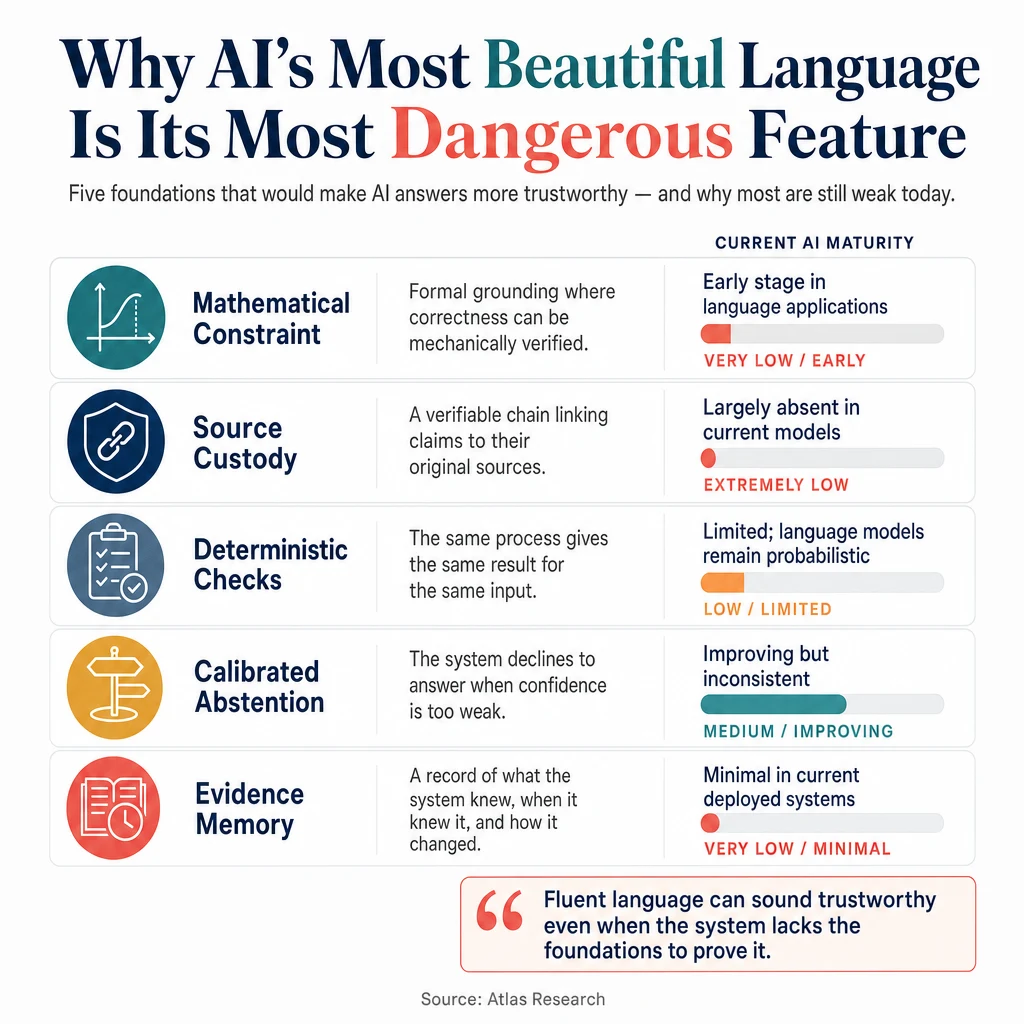
| Verification Pillar | Description | Current AI Maturity |
|---|---|---|
| Mathematical Constraint | Formal grounding where correctness is mechanically verifiable | Early stage in language applications |
| Source Custody | Verifiable chain between claims and their origins | Largely absent in current models |
| Deterministic Checks | Procedures producing consistent output for consistent input | Limited; language models remain probabilistic |
| Calibrated Abstention | System declines answers when confidence is insufficient | Improving but inconsistent |
| Evidence Memory | Record of what the system knew, when, and how it was updated | Minimal in current deployed systems |
FAQs
What is the honesty gap in AI?
The honesty gap is the distance between what AI language models say with fluency, confidence, and social persuasiveness and what can be mathematically or empirically verified as true. It is not merely the presence of errors, but the systematic mismatch between linguistic confidence and verified grounding. The GenXis Research framework defines it as the core structural problem in AI reliability.
Why do AI systems struggle with honesty?
AI systems struggle with honesty because natural language is optimized for persuasion, not verification. Language allows approximation, metaphor, implication, and context dependence features that make it humanly useful but that also allow errors to be metabolized into something that sounds reasonable. As Ledyard and Tyler note, "words can escape meaning" through rationalization, softening, blurring, and reframing. AI systems trained to generate helpful responses inherit these linguistic tendencies without the built-in verification procedures that human reasoners develop over time.
How does the honesty gap impact trust in AI?
The honesty gap impacts trust by making it difficult to distinguish confident errors from confident accuracy. Unlike human advisors whose flawed reasoning often betrays itself through hesitation or inconsistency, AI systems with the same flaws can generate confident elaboration indefinitely. This means that trust calibration the ability to know when to believe a system and when to be skeptical becomes harder as AI systems become more fluent. The very features that make AI trustworthy in casual use are the ones that make it dangerous in high-stakes applications.
What is the difference between AI hallucination and dishonesty?
Hallucination refers to the generation of content that appears well-grounded but is not tethered to source material fabricated citations, plausible-sounding medical explanations that omit key information, authoritative summaries that rely on stale facts. Dishonesty, by contrast, requires deliberate intent to mislead. AI systems that hallucinate are not trying to deceive; they are trying to be helpful, and the helpful response happens to be wrong. The GenXis framework focuses on the structural conditions that produce hallucination rather than the moral question of intent, because closing the honesty gap requires technical solutions, not just ethical training.
How can organizations bridge the AI honesty gap?
Bridging the AI honesty gap requires building verification infrastructure that goes beyond language: mathematical constraint, source custody, deterministic checks, calibrated abstention, and evidence memory. Organizations deploying AI in high-stakes domains should evaluate systems not just on fluency and task completion, but on the robustness of their verification procedures. The education policy precedent suggests that closing the gap is possible where there is sustained commitment to rigorous standards and transparent reporting but it requires accepting short-term costs (reporting poor performance, declining to answer insufficiently grounded questions) in exchange for long-term reliability.