


There's a prevailing myth about fractional executives that needs retiring. The conventional wisdom says you hire one when you cannot afford the real thing when cash is tight, when the startup is too small for a full-time CFO, when you need to sound more established than you are. The consulting industry has done nothing to dispel this framing, positioning fractional seats as budget alternatives to the genuine article.
That story is not just wrong. It is backwards.
The companies getting the most from fractional executive placement are not the ones patching holes. They are growth-stage businesses, scaling operations, and established enterprises navigating specific transitions who have made a deliberate choice: access the judgment and execution muscle of world-class operators without the overhead, equity dilution, and long-term commitment that full-time C-suite roles carry.
The distinction matters enormously in practice. And understanding it is the first step toward using fractional leadership the way the practitioners do not as a stopgap, but as a strategic instrument.

What Fractional Executive Placement Actually Is
Fractional executive placement connects companies with vetted, highly experienced C-suite operators for flexible advisory, project leadership, or integrated fractional roles without full-time overhead. The key word is operators not advisors who counsel from the sidelines, not consultants who hand over binders, but leaders who have owned, led, and scaled businesses and who embed in the organization to drive outcomes.
At its core, fractional executive leadership is a flexible staffing solution that allows businesses to access high-level executive talent on a part-time or project basis. Rather than committing to a full-time executive hire, companies bring in seasoned leaders such as a CFO, CMO, COO, or CTO who work with the organization for a defined period or specific initiative.
The FlexExec model, for instance, organizes its fractional offerings into three distinct engagement tiers: Focused Advisory for decision-making support, Project CXO for advisory plus hands-on leadership around defined initiatives, and Integrated Leadership for embedded executive ownership of a function. Each tier escalates in scope and involvement, allowing companies to match the level of engagement to the decision or gap in front of them.
According to FlexExec's main platform, the company maintains a network of more than 500 vetted executives averaging 15 or more years of operating experience, with a client satisfaction rate of 94 percent. Those numbers matter because they reflect something essential about what fractional placement platforms do: they pre-vet, pre-screen, and pre-match companies with operators whose backgrounds align with their specific needs.
The Consulting Comparison: Why the Analogy Fails
One of the most persistent sources of confusion in the fractional leadership space is the conflation of fractional executives with management consultants. The comparison is understandable both provide expertise on a non-permanent basis but it obscures a fundamental difference in how value is delivered.
Consultants typically diagnose problems and recommend solutions. Fractional executives diagnose problems, recommend solutions, and stay to execute them. They are embedded, accountable participants in organizational outcomes, not outside observers who hand off their findings and depart.
One fractional COO profiled on FlexExec's fractional COO platform describes her approach as fundamentally operational. Olena, who specializes in the digital sector, works with women-led SMEs to transform businesses within six months, focusing on freeing up founder time to concentrate on strategy while she oversees execution. Her method includes an initial video assessment, thorough audit where needed, regular team sessions, and KPI implementation with ongoing monitoring. The language she uses overseeing, implementing, managing is the language of an operator, not a consultant.
Client testimonials on that platform reinforce this distinction. One review notes that Olena was instrumental in organizing account management and operations structure and provided needed experience and best practices to the team. Another describes her ability to streamline operations and contribute to company success as a collaborative and supportive leader. These are not the words people use to describe a consultant who delivered a report and left. They are the words of colleagues describing a working partner.
The Flexing It interim leadership platform makes this operational expectation explicit in its case studies. An Interim CTO engagement with a pharmaceutical company lists as primary responsibilities leading efforts to harmonize data across various systems and platforms, collaborating with senior leadership to develop and implement strategic technology initiatives aligned with organizational goals. This is not advisory output. This is execution ownership.
How Much Does It Cost: The Real Arithmetic
The conventional conversation about fractional executive cost tends to focus on the absence of a full-time salary and the savings that implies. While that framing is not wrong, it undersells the economic logic in a way that can actually mislead companies about what they are evaluating.
A full-time executive carries costs well beyond salary: equity compensation, benefits, onboarding investment, the risk of a bad hire, and the overhead of managing a permanent addition to the leadership structure. Fractional placement eliminates or reduces each of these. But the more interesting economic question is what you get for the investment you make, not just what you avoid.
According to Go Fractional's job listings platform, current hourly rates for fractional roles span a wide spectrum depending on function, seniority, and scope. Roles range from interim positions at $25 per hour for specialized legal work up to $255 per hour for senior finance leadership. More typical rates for established fractional CFOs fall in the $65 to $255 range, while fractional CTO roles in technical domains such as physical AI and robotics command $130 to $230 per hour.
These rates need context. A $75-per-hour fractional marketing director working 10 hours per week delivers the same effective weekly investment as a $75,000 annual full-time salary except without benefits, without equity, without a multi-year commitment, and with the flexibility to scale hours up or down as business needs change.
The FlexExec platform frames the economic case around measurable outcomes rather than cost avoidance alone. Their data shows companies supported by experienced fractional executives report 20 percent higher annual growth compared to organizations without that support. That framing repositions the question from can we afford this to what is the return on executive-grade execution.
Understanding Engagement Models and Investment Levels
The three engagement models available through major fractional platforms map to different investment levels and business situations. Advisory-level engagement through platforms like FlexExec typically includes two decision-focused 90-minute sessions per month, pre-session preparation by the CXO, and post-session guidance that translates discussion into direction. This model suits established leadership teams that need a sounding board with operating experience for critical decisions.
Project-level engagement adds strategy and select project support to the advisory structure, positioning the fractional executive as both counsel and execution partner for a defined initiative. Integrated leadership engagement embeds the fractional executive fully, with ownership of defined executive responsibilities and continuous strategic and operational involvement across core business initiatives.
Companies should resist the temptation to default to the highest engagement level. The practitioner mindset starts with the specific decision, initiative, or leadership gap in front of them and works backward to the minimum viable engagement model. A company navigating a single strategic transition may only need project-level support. A company rebuilding an entire operational function may need integrated leadership. The model should fit the moment, not the other way around.
How to Find and Hire a Fractional Executive: The Practitioner's Workflow
Most companies approach fractional hiring the way they approach full-time recruiting: define a role, post a description, wait for applications, interview, and decide. That process works. But it is designed for permanent hires, and it leaves significant value on the table when applied to fractional placement.
The platforms that have built the strongest track records in fractional executive placement have optimized for speed and match quality rather than candidate volume. Go Fractional's main platform, for instance, promises companies they can hire a fractional executive in three days. Their process asks companies to describe their needs role, scope, and timeline in about two minutes without requiring account creation. A dedicated executive recruiter then matches the company against a network of more than 15,000 pre-screened senior leaders and arranges interviews with suitable candidates within approximately three business days.
That speed is not accidental. It reflects an understanding that the primary value of fractional leadership is responsiveness. A company experiencing a revenue plateau or preparing for a growth inflection does not have months to run a traditional search. They need executive-grade judgment and execution available now.
The match success rate on Go Fractional's platform sits at 98 percent, supported by their 4.7-star Trustpilot rating from over 300 reviews. These numbers suggest that the pre-screening infrastructure verifying qualifications, availability, and interest before presenting candidates creates sufficient quality control to make rapid matching viable without sacrificing placement accuracy.
For companies that prefer a more consultative, full-service approach, firms like Search Solution Group offer fractional executive leadership services with over 20 years of executive recruitment experience. These firms typically conduct deeper intake processes to align fractional placements with specific business challenges, emphasizing immediate impact upon placement rather than extended onboarding periods.
Three Hiring Models to Match Your Moment
Practitioners understand that fractional hiring is not a single mechanism. It is a set of models, each suited to different business situations.
Fractional Access provides senior leadership one to three days per week on an ongoing basis. This model is suited for businesses that need continuous executive presence and judgment without the cost of a full-time seat. It is the default model for growth-stage companies building leadership infrastructure.
Interim Leadership provides full-time senior coverage for three to twelve months during a specific gap, transition, or turnaround. This model suits companies that have lost a key executive and need immediate continuity, or businesses navigating a defined transformation period. The Flexing It platform showcases interim engagements including a six-month Interim CHRO engagement with a legal organization to set up core HR processes, and a three-month Interim CTO engagement with a pharmaceutical company to assess and enhance the technology stack.
Contract-to-Hire allows companies to trial a leader for 30 to 90 days before converting to a permanent hire. This model de-risks executive selection by creating a real-world evaluation period. The job listings on Go Fractional's platform show multiple contract-to-hire positions, including a fractional Head of Talent Acquisition role in New York or Louisiana at 35 to 50 hours per week, explicitly structured as a pathway to permanent employment.
Industries Where Fractional Leadership Pays Dividends
The question of which industries benefit most from fractional executive placement is worth examining carefully, because the answer that most platforms lead with that startups and SMEs need them most obscures a more interesting reality.
It is true that smaller organizations often lack the resources to attract full-time C-suite talent and benefit enormously from access to executive-grade experience. But the FlexExec platform makes a broader case: transformative leadership creates measurable success when experienced operators help diagnose priorities, align the team, and move the business forward. Their platform serves companies across industries including technology, consumer goods, financial services, and professional services, accessing C-suite expertise across finance, marketing, information technology, operations, revenue, and people functions.
Growth-stage companies represent one of the highest-value use cases. The period between product-market fit and scale-up is notoriously difficult to navigate with a founder-driven leadership model. Fractional operators can install operational infrastructure, build repeatable sales processes, establish financial controls, and structure teams without the equity dilution and long-term commitment that recruiting a full executive team requires at that stage.
Established enterprises navigating transitions represent another high-value segment. When a company is integrating an acquisition, pivoting a business model, or responding to competitive disruption, it needs executive experience that its current team may not possess. Fractional placement allows these organizations to access that experience for the specific challenge without restructuring their permanent leadership.
Sector-specific expertise also drives significant fractional demand. The Flexing It interim leadership platform documents engagements across industries including pharmaceuticals, beauty, legal, and fast-moving consumer goods, with interim leaders positioned to address domain-specific challenges such as technology stack harmonization in pharma, financial planning and working capital management in beauty, and HR infrastructure setup in legal.

The Measurable Benefits: What the Data Actually Shows
The conversation around fractional executive benefits often stays qualitative better decision-making, fresh perspective, operational discipline. Those benefits are real, but they are not the whole story. The platforms and practitioners who have been measuring outcomes for years now have data that makes the case more concretely.
The FlexExec platform reports several specific outcome measures from their engagements. Companies where executives have a trusted advisor show 18 percent higher productivity compared to those without. Companies supported by experienced fractional executives show 20 percent higher annual growth. And companies with experienced advisors show 2.5 times higher growth rates compared to organizations operating without that support.
These numbers should be read with appropriate context they are likely drawn from FlexExec's own client outcomes rather than independent controlled studies. But they align with the qualitative feedback that populates review platforms and client testimonials across the fractional executive industry. The consistent theme is that executive-grade judgment, when embedded in the right organizational context, creates operating leverage that compounds over time.
The FlexExec fractional COO platform surfaces a different set of benefits through its practitioner testimonials. Clients describe experiencing a significant alleviation of mental burden, an increase in commercial and operational performance, and a renewed sense of control and pride in their achievements. One client notes that Olena's advanced tactics brought the company to a new level in terms of revenue. Another describes her strategic acumen and ability to streamline operations as having made a profound impact on their organization.
What this means for FlexExec readers is straightforward: the benefits of fractional executive placement are not aspirational. They are documented. Companies that engage experienced fractional operators with clear mandates and measured outcomes are reporting meaningful improvements in productivity, revenue growth, and operational effectiveness. The key variable is not whether fractional leadership works it is whether the company has structured the engagement to unlock its potential.
The Practitioner's Framework: Getting It Right
The companies that extract the most value from fractional executive placement tend to share a common orientation: they treat the fractional engagement as a business decision, not a procurement decision. They define outcomes before they define scope. They match engagement intensity to the challenge in front of them. And they integrate the fractional operator as a working colleague rather than an external resource.
This last point deserves emphasis because it is where many companies subtly undermine their fractional investments. A fractional executive, however experienced, cannot deliver outcomes in isolation. They need access to the team, information, and decision-making processes that allow them to do their work. Companies that treat fractional engagements as black boxes here is the problem, deliver the solution tend to get advisory output. Companies that integrate fractional operators into their working rhythms tend to get embedded execution.
The Go Fractional platform structures its engagement model around this principle, emphasizing that their operators are embedded executives with average experience exceeding 12 years in their fields. Their three-day matching process is designed to reduce friction between need identification and operational start companies can engage month-to-month, scaling hours up or down as needed, without the commitment overhead of traditional executive hiring.
Matching the Model to the Moment
One of the most practical decision frameworks practitioners use involves matching the engagement model to the business situation. Before initiating a fractional executive search, companies should ask themselves several diagnostic questions:
First, what is the primary challenge we are trying to address? If it is decision quality on critical calls, advisory-level engagement may be sufficient. If it is executing a specific initiative, project-level engagement adds the hands-on component required. If it is owning a function or rebuilding an operational area, integrated leadership is the appropriate model.
Second, what is the expected duration of this need? If it is ongoing, fractional access on a part-time retainer basis makes sense. If it is tied to a specific transition or gap period, interim engagement for three to twelve months is the natural fit. If the company wants the option to convert to permanent employment, contract-to-hire provides that pathway.
Third, what level of integration does this engagement require? Some fractional operators can deliver significant value through remote advisory sessions and periodic on-site presence. Others need to be embedded in daily operations to drive execution. The answer to this question shapes the engagement structure, the budget required, and the operator profile that will be most effective.
What the Practitioner Approach Changes
When companies shift from the conventional fractional hiring mindset to the practitioner mindset, the conversation changes in several important ways.
The question moves from can we afford this to what is the return on executive-grade execution. The evaluation criterion shifts from is this cheaper than a full-time hire to does this give us the right expertise for the right duration at the right commitment level. The engagement structure evolves from here is a role description to here is the specific challenge, initiative, or gap we need to address.
The results documented across the fractional executive industry suggest that this shift in orientation produces meaningfully different outcomes. When fractional operators are engaged with clear mandates, appropriate integration, and measured accountability, they deliver results that justify their investment. When they are engaged as cost-reduction mechanisms or status symbols, they tend to deliver advisory output without the execution impact that makes fractional placement genuinely transformative.
The Search Solution Group's fractional leadership services emphasize this point through their positioning: experienced fractional leaders can step in immediately to drive results. The emphasis on immediacy reflects the practitioner understanding that time is a variable in every business challenge, and the value of fractional engagement is partly about the speed with which executive experience can be brought to bear on the problem.
Where to Read Further
For readers who want to explore the fractional executive landscape in more depth, the platforms referenced in this article offer documented case studies, engagement models, and practitioner insights that extend beyond what this overview can cover.
The FlexExec platform provides detailed breakdowns of its three engagement tiers Focused Advisory, Project CXO, and Integrated Leadership along with outcome data from its client engagements. Companies evaluating fractional placement can use this resource to map their specific needs against FlexExec's service structure.
The Go Fractional platform documents its three-day matching process, hiring models (Fractional Access, Interim, Contract-to-Hire), and a job board that provides real-time visibility into current fractional role availability and rate ranges across functions and geographies.
The Flexing It interim leadership platform offers specific case studies of interim executive engagements across industries including pharmaceuticals, beauty, legal, and FMCG, illustrating how different business challenges map to different interim role structures.
For companies in the earlier stages of evaluating whether fractional leadership fits their situation, these resources provide sufficient detail to assess whether the engagement models, operator profiles, and outcome expectations align with their specific context. The practitioner approach begins with information gathering and ends with a clear mandate that is true whether the engagement ultimately makes sense or not.
Summary: Key Principles for Practitioner's Success
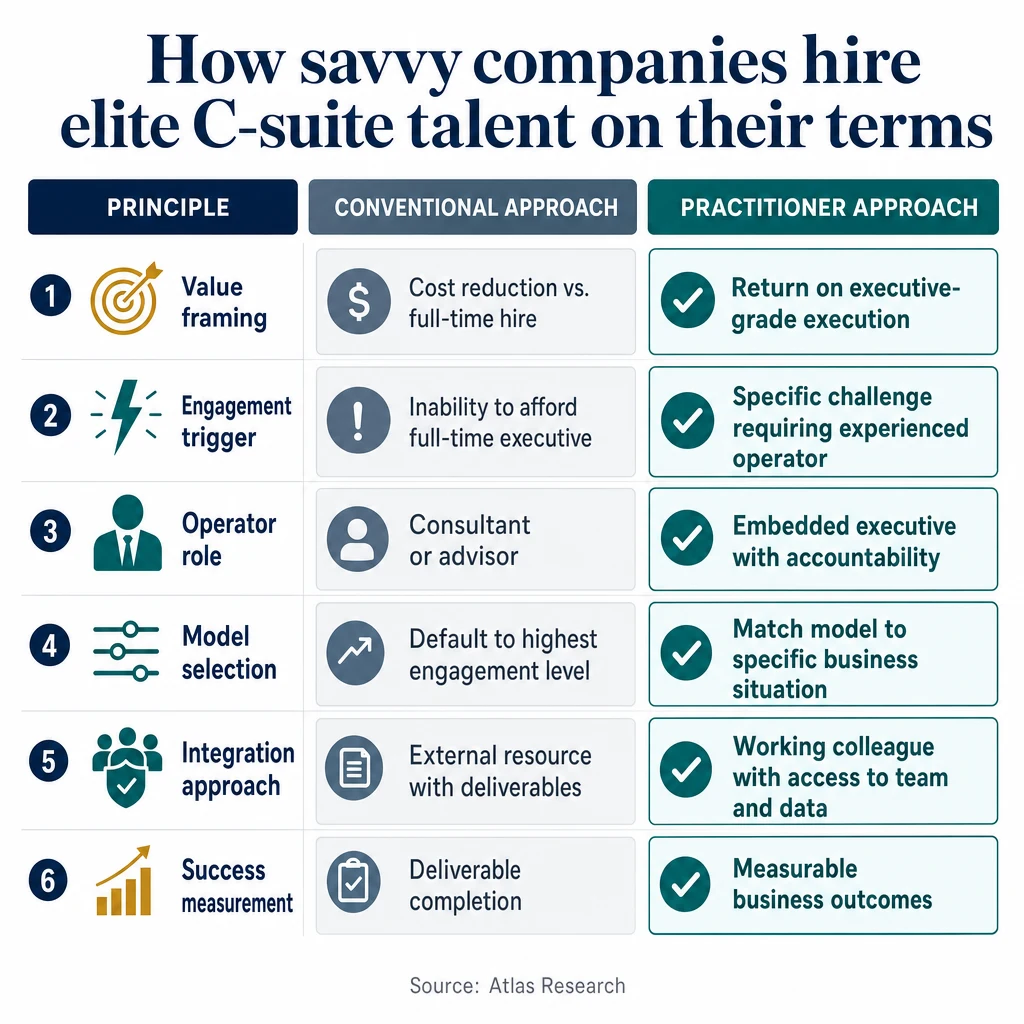
| Principle | Conventional Approach | Practitioner Approach |
|---|---|---|
| Value framing | Cost reduction vs. full-time hire | Return on executive-grade execution |
| Engagement trigger | Inability to afford full-time executive | Specific challenge requiring experienced operator |
| Operator role | Consultant or advisor | Embedded executive with accountability |
| Model selection | Default to highest engagement level | Match model to specific business situation |
| Integration approach | External resource with deliverables | Working colleague with access to team and data |
| Success measurement | Deliverable completion | Measurable business outcomes |
The fractional executive market has matured significantly over the past several years. What was once a niche workaround for companies that could not afford full-time leadership has become a legitimate, strategic instrument in the operating toolkit of growth-stage and established businesses alike. The companies that are extracting the most value from this maturation are the ones that have moved past the conventional framing and approached fractional placement as they would any other executive decision: with clarity about the challenge, realism about the investment, and high standards for the outcomes they expect to achieve.
FAQs
What is the difference between a fractional executive and a consultant?
The key difference is operational accountability. Consultants diagnose problems and recommend solutions; fractional executives diagnose, recommend, and stay to execute. Fractional operators embed in the organization with ownership of defined responsibilities, working alongside the team to drive measurable outcomes rather than delivering reports and departing.
How much does it cost to hire a fractional executive?
Hourly rates for fractional roles range widely depending on function, seniority, and scope. According to job listings data, rates span from approximately $25 per hour for specialized interim positions up to $255 per hour for senior finance leadership. The effective investment should be evaluated against the avoided costs of full-time executive hiring including salary, equity, benefits, and onboarding risk rather than compared only to consultant day rates.
How do I find and hire a fractional executive?
The most efficient pathways are fractional executive placement platforms that maintain pre-vetted networks of experienced operators. Platforms like Go Fractional can connect companies with vetted candidates within three business days. Full-service recruitment firms with fractional practices, such as Search Solution Group, offer deeper intake processes for companies seeking more consultative placement support.
What engagement model should I choose: advisory, project, or integrated leadership?
Model selection should be driven by the specific challenge in front of you. Advisory engagement suits companies that need seasoned judgment on critical decisions. Project engagement adds hands-on execution ownership for a defined initiative. Integrated leadership embeds the fractional executive fully in the organization for ongoing functional ownership. Practitioners recommend starting with the minimum viable engagement level and scaling up if the initial scope proves insufficient.
What does fractional executive placement mean for long-term leadership strategy?
Fractional placement is not inherently a long-term or short-term decision it can serve both. Contract-to-hire models allow companies to evaluate a fractional operator before converting to permanent employment, de-risking executive selection. Ongoing fractional access provides continuous executive presence without the long-term commitment of a full-time hire. The most effective companies treat fractional placement as one tool in a broader leadership strategy, using different engagement models at different stages of their growth.