


There's a quiet consensus forming in vinyl circles, and it goes something like this: the Sony PS-HX500 is the serious choice, the one that serious listeners reach for when they want actual hi-fi performance without selling a kidney. The PS-LX310BT, by contrast, gets filed under "starter deck" a fine little machine for beginners, maybe, but not something you'd build a real system around.
That consensus is tidy. It's also, upon closer inspection, backwards.
Not entirely the PS-HX500 is genuinely a more capable machine in several measurable ways. But the narrative treats "better specs" and "better turntable" as the same thing, and that assumption deserves to be challenged. What the conventional wisdom misses is that the PS-LX310BT was designed around a different philosophy entirely: one that prioritizes how people actually live with vinyl in 2026, not how they theoretically should.
To understand why this matters, we need to look at what each machine actually does and, more specifically, what each one asks of you.
The Automation Question: Why "Fully Automatic" Isn't a Compromise
Let's start with the feature that defines the PS-LX310BT experience: full automation. Press a button. The tonearm lifts, moves into position over the record, lowers gently, and starts playing. When the record ends or when you hit stop the arm returns to its rest, automatically. No balancing counterweights. No fiddling with anti-skate dials. No delicate maneuvering of a tonearm that feels like it might snap if you breathe on it wrong.
Reviewers at Recordbuilds describe the setup process as refreshingly simple: "once the few basic pieces are in place, listening is about as simple as it gets: press one button, the arm moves into position, lowers the needle, and starts playing your record for you." This is not a dumbed-down experience, the site notes it's a legitimate turntable that happens to remove the friction that keeps newcomers from ever getting started.
The PS-HX500, by contrast, operates on manual principles. Its tonearm is straight, with an effective length of 221mm compared to the PS-LX310BT's S-shaped arm at 197mm. That longer effective length does offer advantages in tracking geometry more on that shortly but it also means you're handling the arm yourself every time you want to play a record. For experienced users, this is part of the ritual. For newcomers, it's a barrier that can transform excitement into anxiety.
Simon Lucas at Trusted Reviews called the PS-LX310BT "a super-convenient deck," noting that its simplicity makes it "a good all-round choice for those looking to get into vinyl hassle-free." That's not faint praise it's a recognition that convenience, done well, is a feature beyond a compromise.
Bluetooth: The Feature the PS-HX500 Doesn't Have
Here's where the comparison gets genuinely interesting and where the conventional wisdom starts to crack.
The PS-LX310BT has Bluetooth. The PS-HX500 does not.
This single fact reframes the entire conversation. In 2026, Bluetooth isn't a convenience feature it's a connectivity paradigm. The ability to pair your turntable with wireless speakers, a soundbar, or Bluetooth headphones means the PS-LX310BT can slot into modern living spaces without requiring a dedicated hi-fi rack, separate amplifier, or a nest of cables behind the sofa.
What Hi-Fi's coverage of affordable Bluetooth turntables noted that the market had been sparse for years "it's taken over six years, but we finally have two new, affordable and capable Bluetooth turntables worth recommending," the outlet reported. The PS-LX310BT is one of those two. Its inclusion in that category isn't an afterthought; it's a deliberate design choice that expands what vinyl can be in a wireless world.
The PS-HX500, by contrast, is designed for a traditional signal chain: turntable to phono preamp to amplifier to speakers. That's a beautiful chain if you have it. If you don't, the PS-HX500 becomes a machine that requires additional purchases before it makes any sound at all.
Sound Quality: What the Numbers Actually Tell Us
Let's be precise about what the specifications actually measure, because the raw numbers tell a more nuanced story than the price tags suggest.
Both turntables use MM (moving magnet) cartridges with 2.5mV output and 3g downforce. Both feature belt drive and electronic speed control. Both include switchable phono stages. In these fundamental respects, they're closely matched.
But the differences matter:
- Wow and flutter: The PS-LX310BT measures 0.1%. The PS-HX500 measures 0.25%. Lower is better here the PS-LX310BT is measurably more stable in terms of rotational consistency.
- Base material: The PS-LX310BT uses an aluminum base; the PS-HX500 uses plastic. Heavier, rigid bases generally provide better vibration isolation, which favors the PS-HX500.
- Weight: The PS-HX500 weighs 5.4kg alongside the PS-LX310BT's 3.5kg. Again, mass helps with stability.
- Tonearm effective length: The PS-HX500's 221mm arm alongside the PS-LX310BT's 197mm. Longer effective length generally means better tracking geometry and less inner-groove distortion.
So the PS-HX500 has genuine advantages in build mass and tonearm geometry. These aren't trivial Audiophiles who know what they're listening for will notice the difference. But here's the counterpoint: the PS-LX310BT's lower wow/flutter figure means it's actually more stable in one measurable way. And for most listeners, in most listening environments, the practical difference between these two machines will be far smaller than the price difference suggests.
The detailed comparison at e-catalog.com lays out these specifications in tabular form, making the tradeoffs clear. Neither machine is objectively superior across all metrics the question is which compromises matter to you.
The USB Question: Ripping Vinyl to Digital
One feature that often gets overlooked in turntable comparisons is digital ripping capability. The PS-LX310BT includes a USB B output with a 24-bit/192kHz ADC meaning you can connect it directly to a computer and record your vinyl collection in high resolution. The PS-HX500 has no USB connection at all.
This isn't a minor point. In an era where music libraries are increasingly digital, the ability to preserve your vinyl collection or create digital backups of rare pressings has real value. The PS-LX310BT makes this straightforward: connect, record, archive. The PS-HX500 offers no such path.
For collectors with extensive vinyl libraries, this difference alone might justify the PS-LX310BT's inclusion in a system even if the PS-HX500 remains the primary playback deck.
Is the PS-HX500 Worth the Extra Money?
Let's talk about the elephant in the room: price. The PS-LX310BT typically retails between $248 and $448, while the PS-HX500 starts around $500 and can run higher. That's a meaningful gap sometimes nearly double.
The honest answer to whether the PS-HX500 justifies its premium depends entirely on your context. If you already have a quality phono preamp, a proper amplifier, and a set of speakers that can reveal the differences between these machines, then yes the PS-HX500's superior build quality and longer tonearm will translate into audible benefits. The aluminum base and additional mass will provide better isolation from vibrations. The longer tonearm will track more accurately, particularly in the inner grooves where distortion tends to accumulate.
But if you're building a system from scratch or if you're looking for a turntable that can work with the wireless speakers already in your living room the calculus changes. The PS-LX310BT's built-in phono stage means you don't need to buy a separate preamp. Its Bluetooth connectivity means you don't need an amplifier at all. Its automation means you don't need technical knowledge to get great results. Its USB output means you can digitize your collection without additional hardware.
When you factor in the entire system cost, the PS-LX310BT often represents better value not because it's the better machine in isolation, but because it doesn't require you to buy everything else to use it.
What This Means for Sony Readers
Sony has positioned these two turntables as complementary more than competing. The PS-LX310BT is the accessible entry point: fully automatic, Bluetooth-enabled, USB-ready, and easy to live with. The PS-HX500 is the enthusiast's choice: heavier, more precise, and designed for listeners who already understand what they're looking for in a turntable.
The conventional wisdom treats the PS-HX500 as the "real" Sony turntable and the PS-LX310BT as the budget alternative. But that framing misses what makes each machine distinctive. The PS-LX310BT isn't a lesser version of the same thing it's a different thing, optimized for different priorities. If those priorities match yours, it's not a compromise at all.
For readers researching their first turntable, the PS-LX310BT deserves serious consideration. Its combination of automation, Bluetooth, and USB ripping makes it one of the most flexible entry points into vinyl currently available. For readers with existing hi-fi systems looking for a dedicated playback deck, the PS-HX500 offers genuine audiophile performance provided you're willing to pay the premium and supply the rest of the signal chain.
The question isn't which turntable is better. It's which turntable is better for you.
Head-to-Head: Key Specifications
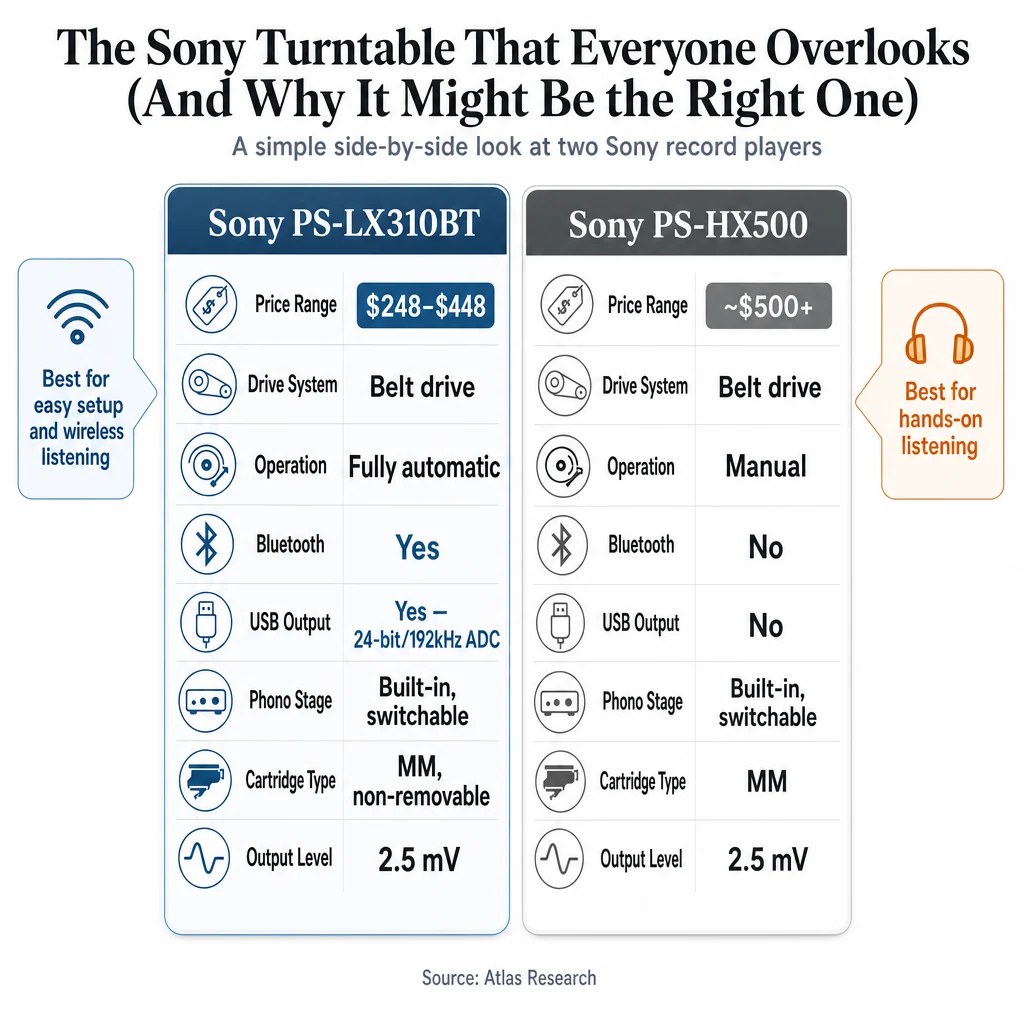
| Feature | Sony PS-LX310BT | Sony PS-HX500 |
|---|---|---|
| Price Range | $248 - $448 | ~$500+ |
| Drive System | Belt drive | Belt drive |
| Operation | Fully automatic | Manual |
| Bluetooth | Yes | No |
| USB Output | Yes (24-bit/192kHz ADC) | No |
| Phono Stage | Built-in, switchable | Built-in, switchable |
| Cartridge Type | MM, non-removable | MM |
| Output Level | 2.5 mV | 2.5 mV |
| Downforce | 3 g | 3 g |
| Tonearm Shape | S-shaped | Straight |
| Tonearm Length | 197 mm | 221 mm |
| Base Material | Aluminum | Plastic |
| Weight | 3.5 kg | 5.4 kg |
| Wow & Flutter | 0.1% | 0.25% |
| Signal-to-Noise Ratio | 50 dB | 50 dB |
| Platter Size | 296 mm | 296 mm |
| Dimensions (WxDxH) | 430×367×108 mm | 430×366×104 mm |
Making the Choice: A Practical Framework
If you're still deciding, here's a simple way to think about it. Ask yourself three questions:
1. Do you already have a hi-fi system?
If yes, and it includes a phono input or you have a separate preamp, the PS-HX500's superior build and longer tonearm will integrate seamlessly. If no, the PS-LX310BT's built-in phono stage and Bluetooth connectivity mean you can start listening immediately.
2. How much setup do you want to handle?
If you enjoy the ritual of setting up a turntable balancing the tonearm, adjusting anti-skate, carefully placing the cartridge the PS-HX500 rewards that knowledge. If you want to press play and hear music, the PS-LX310BT's automation handles everything.
3. Do you want to digitize your records?
If preserving your vinyl collection digitally matters, the PS-LX310BT's USB output makes this straightforward. The PS-HX500 offers no path to digital archiving.
Neither answer is wrong. The PS-LX310BT and PS-HX500 represent two valid philosophies of vinyl playback one that embraces modern convenience, one that honors traditional audiophile values. The "right" choice depends on where you are in your vinyl journey and what you want from the experience.
Where to Read Further
For deeper dives into the PS-LX310BT's performance and real-world use cases, Trusted Reviews' full assessment by Simon Lucas offers detailed listening impressions and setup notes. Recordbuilds' review focuses on the newcomer experience, walking through what to expect from unboxing through first play. And for a comprehensive side-by-side specification comparison, e-catalog.com's comparison tool lets you examine every metric in detail.
What Hi-Fi's broader coverage of the Bluetooth turntable market placing the PS-LX310BT in context against its limited competition provides useful background on why wireless vinyl playback matters in 2026.
Ultimately, both of these Sony turntables represent the company's commitment to making vinyl accessible at different price points and for different types of listeners. The PS-LX310BT opens the door wide. The PS-HX500 rewards those who walk through it with knowledge and intention. Neither is the wrong answer it depends on what you're looking for.